
Frankenbranding: How to Create On-Brand Creative Assets Across Teams With One Claude Skill
There’s a monster loose in your marketing department.
The scariest thing B2B marketing leaders are facing this season has nothing to do with pipeline, MQLs, or AI search strategy.
It’s sneakier than all of that. And it might already be chipping away at your firm’s reputation, your board’s confidence in your ability to tell the company’s story, and most of all... your sanity.
I call it Frankenbranding.
Frankenbranding (noun): The mashed-together, almost-correct creative mess you get when different people, teams, and vendors build their own decks, landing pages, and social graphics with no designer, no system, and nothing keeping them on-brand.
You see it every single week.
You invested real money in a brand identity you’re proud of. Then sales, marketing ops, partners, and three different vendors start making their own assets with it. Six months later your brand looks like it was stitched together in a basement lab at 2am, bolts sticking out of its neck and everything.
So is it a creative quality problem? A communication problem? A design problem?
Well, according to Gartner, brand governance is becoming an AI governance issue, not merely a design-system issue.
Most branded creative used to flow through marketing, design, an agency, or a creative team.
Now…
Sales can make a presentation in ChatGPT.
HR can make recruitment ads in Canva AI.
A regional marketer can generate campaign images in Midjourney.
A product marketer can write copy in Claude.
A sales rep can create a landing page using Gemini.
The bottleneck LITERALLY disappeared.
Which is great for velocity!
But the creative department has also historically been a governance layer.
AI removes both at once.
And this is how the monsters get in.
Every model has a different interpretation of your brand
A traditional brand guide might say:
Voice: confident, human, optimistic, straightforward.
But Claude, ChatGPT, Gemini, Copilot, Jasper, Canva, Adobe Firefly, and dozens of vertical AI tools may interpret those four adjectives differently.
Frontify describes this problem in its 2026 work around machine-readable brand guidelines: if ten teams across regions use different AI tools, simply giving everyone the same PDF brand guide does NOT mean those systems interpret or apply it consistently.
Humans can interpret a brand book, sure.
AI needs brand context it can actually ingest and enforce.
AI multiplies the Frankenbranding
This is what makes the problem WAAAAAAY different…
Adobe found that demand for creative content has at least doubled over the previous two years, while more than eight in ten marketers update campaigns weekly and more than one-third do so daily.
Historically…
10 people × 10 assets = 100 opportunities for brand drift.
Now:
1,000 employees × AI × hundreds of variations = potentially tens of thousands of brand expressions.
And AI makes each variation nearly free.
So the organizational problem changes from:
“How do we approve everything?”
to:
“How do we make everything inherently understand the brand?”
That is a very different infrastructure problem.
And we already know inconsistency is expensive!
Lucidpress/Marq’s research of more than 450 organizations found:
77% of companies dealt with off-brand content.
Organizations estimated that consistent branding could increase revenue 10–20%.
And 85% were already creating more content than the previous year. pub.lucidpress.com
AI basically pours gasoline on an existing brand-management problem. It feeds the MONSTER!
There is also a trust consequence
Canva’s 2026 research found 97% of marketers use AI daily, but consumers are increasingly sensitive to the quality of AI-generated brand content.
Gartner’s 2026 consumer research is even more striking:
50% of U.S. consumers prefer doing business with brands that don’t use GenAI in consumer-facing content.
68% frequently wonder whether content they see is real.
Bad AI creative is becoming a brand trust problem.
So no, the answer isn’t banning AI. It’s giving AI the rules.
Where most B2B brand strategy falls apart
Every employee is becoming a creative department.
Every AI is becoming a brand representative.
Almost no company has built the infrastructure to govern either.
For now, here’s something that will help… 👇🏼
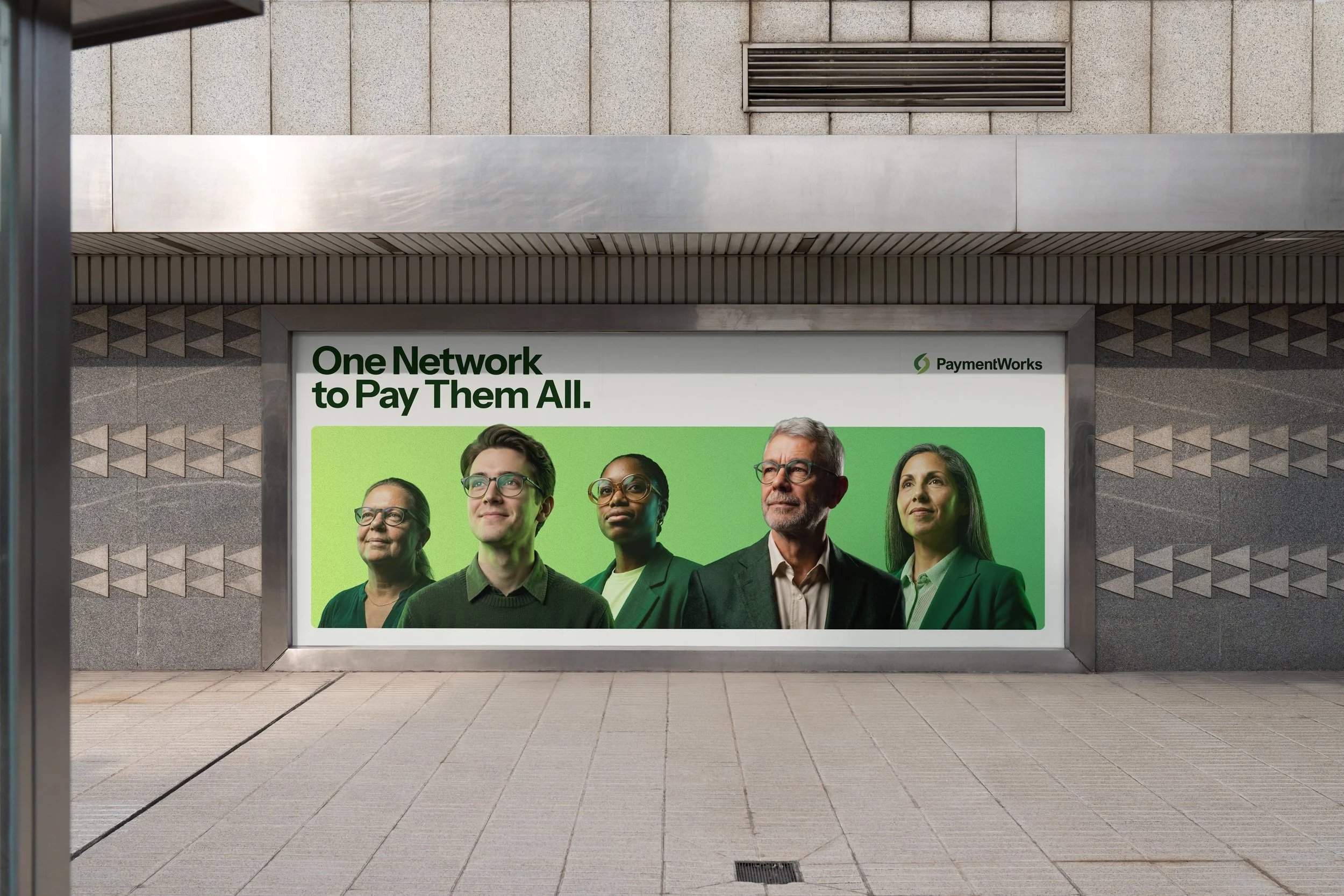
(We helped PaymentWorks defeat Frankenbranding with this epic rebrand that went live earlier this year!)
But first, who’s on the hook when your firm’s brand shows up wrong?
It’s Thursday at 4:47pm. Someone in sales just built a deck with AI in 20 minutes and they are pumped about it. “Almost” your-blue, rounded cards everywhere, and a purple gradient nobody ever approved. And a tagline that no one in your firm has ever said or used… even ONCE.
It goes in front of your biggest prospect tomorrow at 9am.
And you let it slide, because what else are you going to do at 4:47 on a Thursday?

Multiply that by every rep, partner, and contractor with a design tool in their browser. That’s how you get Frankenbranding.
Your business pays for it: Buyers can’t remember a brand they can’t recognize, so every off-brand asset spends down equity you paid years to build. Your premium price starts looking like a guess. Your designers (or you) turn into a cleanup crew.
The hardest part about this for you: YOUR name is on this. When the CEO holds up two one-pagers that look like different companies made them, everyone in the room turns to you.
You become the brand cop reviewing decks at 10pm on a Sunday. And every off-brand asset strengthens the argument to your CFO that “marketing is just decoration,” which is the first line item cut when budgets get tight.
The fix: Destroy Frankenbrand’s monster and give your AI the brand skill it needs

At Forrest, we got tired of cleaning up Frankenbranded assets for our clients (and, if I’m honest, for ourselves too).
A few months ago we built a Claude skill that works like a senior brand designer and a UI expert rolled into one. It reads your actual brand system, follows it, and calls out anything that drifts. We use it every week, and we keep sharpening it.
Sure, there are plenty of platforms promising brand consistency and creative quality. But who has the budget (or the patience) for five more seat licenses and another onboarding call? This gives your team the same guardrails without another tool to buy.
Re: AI Skills: Our hot take

Skills are only as good as the humans who build them.
You probably already know that skills are just a set of instructions Claude reads before it starts working. That’s why we see so many AI design tropes like rounded corner cards, eyebrow text, etc. across every single brand or team that’s using AI in any way to design things.
Even with brand guidelines to pull from, AI will still guess and hallucinate.
We built this skill to kill the hallucination at scale.
So instead of guessing what “on-brand” means, it follows your actual system. Install it once, and every person on your team who uses Claude is working from the same rulebook and the same design brain.
This skill we’re using was created over a series of months by our top, award-winning designers, compiled from years of brand design at the highest level, and literally thousands of B2B deliverables.
Senior-level design at scale: what the skill actually does

We helped Optura.ai create a brand foundation that got them ready for Series A last year.
✅ Connect your Figma file and it pulls your real brand tokens, type styles, and grid straight from the source.
✅ Enforces your layout grid on every single element.
✅ Treats your reference designs as a system to extend, rather than a mood board to riff on.
✅ Blocks the usual AI design clichés, like gradient blobs, glassmorphism, bento grids, and surprise extra typefaces.
✅ Art-directs imagery around your message instead of grabbing generic tech stock.
✅ Refuses to invent testimonials, metrics, or customer logos to fill a layout.
✅ Covers accessibility and every interaction state for web work.
✅ Create mode builds new work inside your brand system.
✅ Review mode audits any design, yours or a vendor’s, and names the exact fix for each issue.
👉🏼 Try it now.
Kiss Frankenbranding goodbye for good.
Give it a try and let us know. Lay a sales one-pager, a partner deck, and a contractor’s landing page side by side on the conference table. For the first time, they look like one company made them, right down to the gap between a headline and the line underneath it.
That’s HOW quality + consistency start compounding.
Your teams move faster because the system polices itself. Your designers get back to the work that moves pipeline. And brand becomes something you can defend in a budget meeting with a straight face and a stack of proof.
Stop being the bottleneck and start being the architect. You go from approving off-brand decks at 10pm to leading a brand that shows up right whether you have to create it or not.
The Series-A-sized question?
How many assets went out under your name this week that you’d be embarrassed to defend?
GO AND KILL Frankenbrand’s monster!
Recommendations:
1. Use this skill with the LLM of your choosing.
2. Use it WITH Figma or Canva via MCP connection. Works best for us in Claude Cowork, connected to Figma.
3. Use the skill alongside your brand guidelines, NOT in place of them. You need to use both!
4. Make sure you’ve given your model an approved image library of any photography/imagery that you’re creating with.
Download the free skill here, install it, and let your team build without the spooky results.
Let’s go!
Sources:
Adobe, The Search for Impact in an Era of Speed
https://business.adobe.com/resources/sdk/the-search-for-impact-in-an-era-of-speed.html
Microsoft WorkLab, AI at Work Is Here. Now Comes the Hard Part
https://www.microsoft.com/en-us/worklab/work-trend-index/ai-at-work-is-here-now-comes-the-hard-part
Deloitte, Shadow AI: GenAI in the Workforce
https://www.deloitte.com/uk/en/issues/generative-ai/genai-workforce-survey-shadow-ai.html
Deloitte, Connectivity and Mobile Trends Survey
https://www.deloitte.com/us/en/insights/industry/telecommunications/connectivity-mobile-trends-survey.html
Adobe, Creatives Say AI Is Helping Them Meet Growing Demand for Content
https://blog.adobe.com/en/publish/2026/04/17/creatives-say-ai-helping-them-meet-growing-demand-content-improving-their-work
Gartner, Marketers Must Get Better at Training AI for On-Brand Content Creation
https://www.gartner.com/en/newsroom/press-releases/2025-03-17-marketers-must-get-better-at-training-ai-for-on-brand-content-creation
Gartner, Generative AI and Brand Risk / Governance Research
https://www.gartner.com/en/documents/6906066
Frontify, Brand Guidelines for AI
https://www.frontify.com/en/guide/brand-guidelines-for-ai
Lucidpress / Marq, State of Brand Consistency Report
https://pub.lucidpress.com/5026f8f1-6004-496e-b308-71662d214bb3/document.pdf
Marq, Brand Style Guide and Brand Consistency Research
https://www.marq.com/blog/brand-style-guide/
Canva, Marketing & AI Report 2026
https://www.canva.com/marketing-ai-report/
Gartner, 50% of Consumers Prefer Brands That Avoid GenAI in Consumer-Facing Content
https://www.gartner.com/en/newsroom/press-releases/2026-03-16-gartner-marketing-survey-finds-50-percent-of-consumers-prefer-brands-that-avoid-using-genai-in-consumer-facing-content0
Adobe, Adobe Introduces Brand Intelligence
https://news.adobe.com/news/2026/04/adobe-introduces-brand-intelligence
Frontify, Frontify + Microsoft Copilot
https://www.frontify.com/en/blog/frontify-microsoft-copilot
